
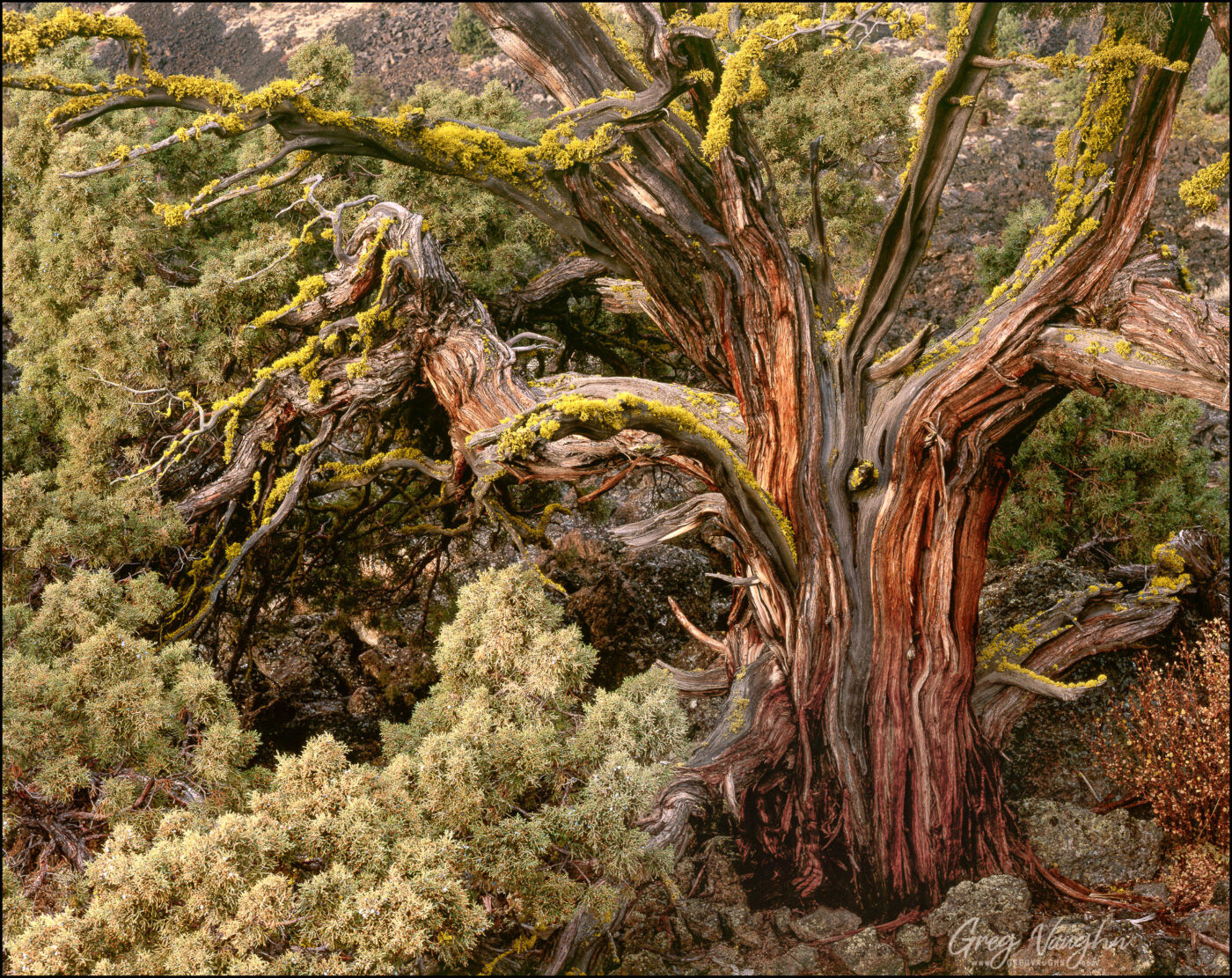
Rummaging through my office a few days ago, I came across a stack of CDs from years ago when I had some of my 4×5 and medium format transparencies scanned. Surprisingly, I had never uploaded this one to my computer or done any editing to the file.
Being a scan from a sheet of properly exposed Fuji Velvia film, it only needed a few minor adjustments in Lightroom. A little less saturation and opening the shadows at the base of the tree. But doing that gave me the opportunity to really look at and appreciate the photo. Not just for the beauty of the tree, which of course is why I made the photo, but also to analyze why it works as an image.
When I’m out photographing, I certainly consider some basic composition tenets and framing, but mostly it’s just “Oh, that looks good.”
A few days ago, I watched an excellent webinar by Muench Workshops pro David Thompson, where he talks about how he creates his beautiful photographs. DT explained how he looks for visual flow, balance, color contrast, etc. I realized that I don’t normally do much of that, but I should consciously consider those elements, so here’s what I came up with for this juniper photo.
- Framing: I didn’t need to include the whole tree to tell its story or show its beauty, and I did want to eliminate any distracting elements on the edges and in the background.
- Composition: Rule of Thirds happening here with the tree trunk on the right third. Did I purposely compose that way? Not so much, as I recall – there was nothing interesting that would add to the image to the right of the tree, whereas the foliage to the left definitely did.
- Balance: The shape and heaviness of the tree trunk on the right is balanced by the mass of delicate foliage on the left.
- Color contrast: The reddish bark and greenish foliage kind of work as complementary colors, with the warm reds grabbing the attention initially.
- Visual flow: My eye goes first to the gnarly main trunk of the tree, then follows the arc of the branches up and around to the left, which leads down to the foliage. The shape of the foliage at the bottom, with the help of the dark gap, points me back to the tree trunk. My eye keeps going in circles within the frame, giving me more opportunity to notice all the details and ponder the wonder of this magnificent tree.
This was a fun exercise. Do you look at your photos, or images by photographers you admire, and analyze them in a similar way?






 by
by 